Pachinko industry has been forming a huge consumer market in Japanese leisure market.

According to the "Leisure White Paper 2025" published by the Japan Productivity Center, the market size of the "entertainment section," which includes the pachinko industry, is approximately 50 trillion yen within Japan's leisure market. Of that, the pachinko and pachislot industry accounts for 32%, representing a market size of 16 trillion yen.Additionally, according to the "2016 Economic Census for Business Activity," the number of employees at pachinko halls across Japan is about 230,000. This workforce is comparable to that of industries such as steel manufacturing, department stores, and supermarkets, contributing to job creation.
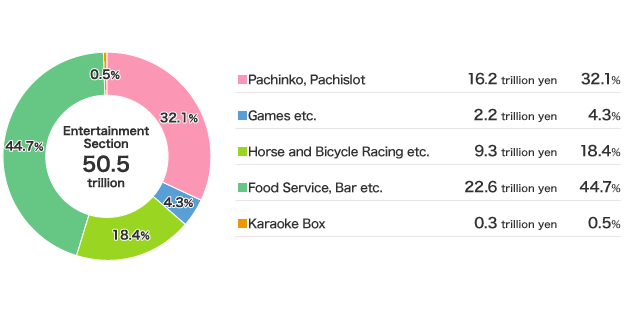
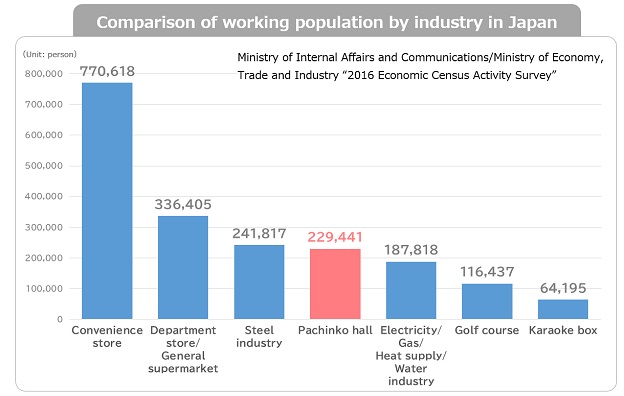
The industry comparison data was compiled by the Pachinko and Pachislot Industry 21st Century Association as the "Amusement Industry Report 2025."
Pachinko is one of the most popular entertainment in Japan.


There are two types of game machines in pachinko halls; one is called pachinko machine and the other one is called pachislot machine. Pachinko machine is often described as vertical pinball machine which shoots small metal balls continuously toward the board surface of pachinko machine. Players are aiming to gain balls by shooting down into a winning pocket located at bottom center of the board surface. Playing costs are generally within the range of 0.5 yen to 4 yen per ball. Procedure of pachislot game, quasi slot machine, starts from inserting tokens into slit and rotating reel drum to match patterns on the drum for winning tokens. Playing costs are generally 5 yen to 20 yen per token. Players can rent balls or tokens to play games and exchange for gift prizes or charge their membership card electronically for the next visit with their winning balls or tokens.

Players can exchange their winning balls and tokens for general prizes or so-called G-prizes. General prizes include commodities of which items are sold at convenience stores such as daily necessaries, confectionery and cigarettes. On the other hand, G-prizes mean decorative cards with a small embedded piece of gold or silver or coin-shaped pendants of gold or silver.
We are arranging about a thousand of general prizes and offering catalogue for our customers to select their favorite items. For the seasonal event like Christmas and Halloween, we are offering up-to-date special gift prizes to our customers to improve our services.

Pachinko machines appeared in Japan as a toy for the first time during the 1920s. And after that, pachinko machines had developed rapidly in Nagoya area as a recreation for adults around 1930. Although pachinko halls had been closed down during the World War II, they restored their business in the latter half of 1940s. Pachinko machines were simply composed of bells and flash lamp at that time. Currently popular machine with video screen and sound device was originally introduced back in 1980s.
Slot machine was invented in the United States in 1899. Several decades later, SEGA Enterprises, game console manufacturer, introduced the first pachislot machine in Okinawa after improving the original slot machine. The first machine was named "Olympia Machine" due to the Tokyo Olympic was held in the same year coincidentally. Playing method was simply pushing the stop button to match patterns on the rotating reel drum unlike the current computer-controlled movement.

Gaming experience has been much more enhanced nowadays by incorporating computer chip, stereophonic sound system and liquid crystal video display into pachinko and pachislot machines to show popular animation characters and other topical contents.
Playing costs for each of the pachinko and pachislot used to be 4 yen per ball and 20 yen per token until an introduction of 1 yen pachinko in 2006. Lower playing costs of pachinko made it possible to reduce the gambling aspect of the game and enhanced the entertaining attribute. Lower playing costs were introduced as a counter-measure for decreasing players' population that enables players to stay longer in our halls with lower expenses.
Approximately 1,612 hall operating companies are managing 6,464 halls nationwide as of 31 December 2025.
